 EN
EN
 English
  русский
  Español
  Deutsch
  عربى
عربى 
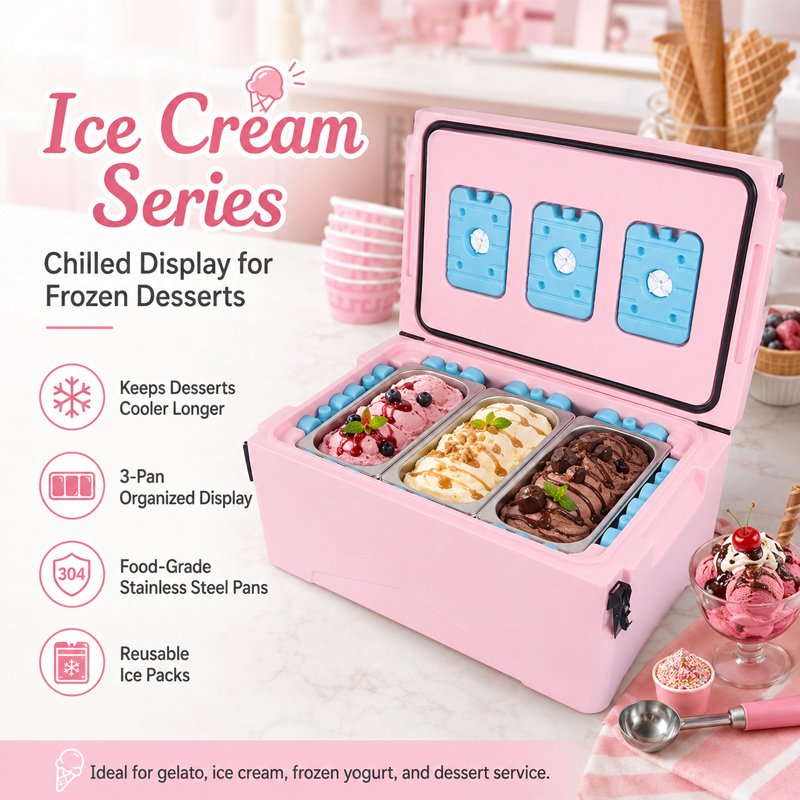
This mobile insulated ice cream display cooler is fitted with three stainless-steel pans, each approximately 6.6L / 7QT, in an overall body of about 69.5 × 44.5 × 32 cm. The separate pans allow differ...
See Details
How a Cooler Box Works: Insulation, Ice Retention and Real-World Performance
2026-09-10
On a hot August weekend, two families drive to the same lakeside campsite with the same brand of bagged ice and the same number of drinks. One family is still cracking ice on Monday morning. The other is drinking lukewarm soda by Saturday night. Both parked in the sun, both opened their boxes about the same number of times. The only real difference is the box itself - not the label, but the way its walls, seal, and insulation were engineered to slow down the one thing every cooler box must fight: heat.
A cooler box is a passive thermal container. It does not make cold air. It does not contain a compressor, a thermoelectric module, or any other cooling machinery. It creates a protected interior space and then tries to keep heat from crossing the boundary. The cold inside comes from something you pack into it: ice, frozen gel packs, dry ice, or simply food and drinks that were already cold.
To understand how a cooler box works, you need three pieces of knowledge: the physics of heat transfer, the behavior of ice as a cold sink, and the construction details - molding process, wall thickness, gasket, and hardware - that determine whether the box protects that cold for six hours or six days. This guide covers all three, and finishes with practical buying and sourcing criteria.
A Cooler Box Works by Slowing Heat Entry, Not by Producing Cold
The starting point is a law of physics you cannot negotiate with: heat moves from a warmer body to a cooler one. When a campsite at 32°C surrounds a cooler interior at 0°C, the temperature difference creates pressure for heat to flow inward. The box does not leak "cold" out; cold is the absence of heat. Heat is actively trying to get in. The box's entire job is to put as many barriers as possible in heat's path.
Conduction: the fight through the walls
Conduction is heat transfer through solid material by molecular vibration. The plastic shell of a cooler box is a thermal conductor, but not a very good one; still, a thin plastic shell alone would melt ice quickly because the wall is so thin. The insulation layer is where conduction is really stopped. Almost every modern cooler uses rigid polyurethane foam, a material packed with tiny closed cells filled with low-conductivity gas. The gas cannot circulate, so heat has to pass through cell wall after cell wall, and each transfer slows it down.
The exact numbers matter more than marketing phrases. Unfilled plastic conducts heat at roughly 0.2 to 0.4 W/m·K. Polyurethane foam is between 0.02 and 0.03 W/m·K. That is roughly ten times more resistant per millimetre. Consequently, 40 millimetres of foam gives you a wall that is roughly equivalent to 400 millimetres of solid plastic, which is why a good cooler is built as a thin plastic sandwich around a thick foam core. Every extra centimetre of foam buys more insulation, which is why high-performance boxes have visibly thick lids and walls.
Convection: the air exchange cost
Convection moves heat through air or liquid. Inside a closed cooler, the main convection event happens every time the lid opens. Warm air from outside pours in, cold air spills out, and the ice must then absorb the heat of the new air. A cooler that is opened frequently melts ice noticeably faster than one that stays shut. But even with the lid closed, internal convection can matter: if the box is only one-third full, a large pocket of air sits above the cold items, and warm air circulating at the top transfers heat downward into the contents. Filling dead space with towels, frozen bottles, or more ice limits this effect.
Sealing is the cure for external convection. A continuous gasket that compresses into a foam track blocks the movement of air completely. That is why the condition of the gasket, not just the wall thickness, is the first thing to inspect on any cooler box.
Radiation: the sunload problem
Radiation transfers energy through electromagnetic waves, and it reaches the cooler even without direct contact. Sunlight heats the outer shell; the shell warms the foam; the foam slowly passes the heat inward. The impact is measurable: a dark-colored cooler sitting in full sun absorbs substantially more heat than a lighter one, and a box in the shade can hold ice hours longer than the same box in direct sunlight.
Some marine and offshore boxes use light-colored or textured shells partly for this reason. Users can reduce radiative load with the simplest tools - a tarp, a reflective windshield shade, or placing the box under a table. The mechanism inside the cooler remains passive; the user controls how much radiation it has to face.
Inside the Walls: Insulation Materials and Construction
Open up a quality cooler box and you find a sandwich structure: a food-grade plastic inner liner, a thick layer of rigid foam, and a tough outer shell. The inner liner must be smooth and easy to clean because it touches food and drinks; the outer shell must resist drops, UV exposure, and scratching; and the foam between them is the real working material.
Why polyurethane foam outperforms cheap alternatives
Not all foam is equal. The denser foam in a quality rotomolded cooler is usually rigid polyurethane with a closed-cell structure. The cells trap a gas with very low thermal conductivity, and the closed-cell structure prevents water from soaking in. Cheaper coolers sometimes use expanded polystyrene, the white bead foam of budget picnic boxes, which has decent thermal resistance initially but crushes easily and absorbs water over time. You can often spot the difference at the cut foam edge around the drain plug or hinge: closed-cell polyurethane looks dense and fine-grained, while expanded polystyrene looks like fused beads.
Foam density and fill quality matter as much as chemistry. If the foam is injected as a liquid into the cavity, it expands and fills every gap; if it is a pre-cut board, there will be voids and seams where heat bypasses the insulation. A seamless, fully foamed cavity is one of the quiet engineering reasons why more expensive boxes hold ice longer.
Seamless shells keep insulation dry
Insulation fails permanently when it gets wet. Water has a thermal conductivity around 0.6 W/m·K, roughly twenty to thirty times higher than foam. A foam layer that is soaked becomes a thermal short circuit, and the box will never hold ice properly again. This is why shell construction is not just a durability question: any seam, crack, or injection point that lets water into the foam destroys the box's core function.
Rotomolded bodies have a strong advantage here because they are molded as a single seamless piece. There is no separate bottom welded to the wall, no inner shell that can separate from the outer shell. Injection molded coolers can also perform well if the inner and outer shells are bonded completely and the foam cavity is sealed, but the multi-part design inherently creates more places where water can enter over years of use.
The lid deserves the thickest insulation
Heat rises, and the lid of a cooler faces direct sun and warm air all day. Yet many budget coolers skimp on lid thickness because lighter lids are easier to hinge. A well-engineered lid is nearly as thick as the body and sits on a full-perimeter gasket. Some premium boxes add a sealed, air-tight dead space inside the lid that acts like an additional foam board. When comparing boxes, press on the lid's inner surface: a lid that flexes noticeably under your palm is a lid that will cost you ice.
The same logic applies to marine and commercial fish tubs. The largest rotomolded tubs are made with very thick walls and heavy lids, because the economic value of a single lost catch far exceeds the extra plastic. The working principle is identical; it is simply applied with more material.
The Cold Source: Ice, Phase Change, and Pack Strategy
A cooler box is only a shield. The actual work of extracting heat from food and drinks is done by the cold source you put inside. Ice is the overwhelming favorite because of its physics, but not all ice behaves the same way.
The hidden power of melting ice
Ice absorbs energy most efficiently when it is melting. The heat required to convert one kilogram of ice at 0°C into water at 0°C is about 334 kilojoules. That is the latent heat of fusion, and it is huge compared to the heat required to warm already-melted water. To put it in familiar terms: the energy absorbed while melting one kilogram of ice could instead raise the temperature of one kilogram of water by about 80°C. This is why a lump of ice is so much more effective at cooling a warm drink than the same weight of cold water.
It also explains why you should not dump meltwater out too often. As long as meltwater stays near 0°C, it can still absorb heat from warmer contents. Removing meltwater removes cold mass from the system. The only real reasons to drain are to create space or to prevent food from sitting in water.
Block ice, cubes, crushed ice, and the packing ratio
Block ice has little surface area relative to its volume, so it melts slowly and lasts longest. Cubed ice is a compromise: enough surface area to cool contents reasonably fast, but a much shorter life. Crushed ice chills fast because it exposes the maximum surface area, but those same small pieces melt away in a matter of hours. For a multi-day trip, the practical strategy is to place a block of ice at the bottom, then distribute cubes or crushed ice between items.
The packing ratio matters more than the ice shape. For serious cooling, use two parts ice to one part contents by volume. For overnight or day use, one-to-one is often enough. This ratio also assumes the contents were pre-chilled; warm contents will consume their weight in ice just to come down to temperature.
Dry ice, gel packs, and phase-change materials
Dry ice is solid carbon dioxide at -78.5°C. It can keep a cooler far below freezing for several days and leaves no meltwater. But it must be handled with gloves, must not be sealed in an airtight box because the gas expansion creates dangerous pressure, and must be kept away from direct contact with skin and carbonated drinks. It is a professional tool, not an everyday camp companion.
Gel packs and phase-change materials are reusable and thermally stable. Standard gel packs freeze at roughly 0°C; phase-change packs are formulated to melt at a specific temperature, sometimes as low as -2°C or -5°C for seafood. Their advantage is neatness and reusability; their disadvantage is that a gel pack stores much less cold per kilogram than ice, so they cannot replace ice on long trips. They are excellent for a short commute or when meltwater is unacceptable.
| Cold source | How it works | Best use case |
|---|---|---|
| Block ice | Large solid mass, low surface area, slow melt, steady 0°C | Multi-day trips, fish storage on boats |
| Cubed ice | Fast surface contact, moderate melt rate | Day trips, drinks, picnic coolers |
| Crushed ice | Maximum surface area, very fast chilling, quick melt | Rapid cooling of fish and seafood, short events |
| Dry ice | Sublimates at -78.5°C, extreme cold, no water | Frozen food transport, no-melt requirements with ventilation |
| Gel or PCM packs | Frozen reusable packs, stable phase-change temperature | Commutes, small boxes, backup cold for medical or food items |
Rotomolding vs Injection Molding: How the Shell Changes Performance
The molding process determines everything: how thick the walls are, whether the body is seamless, how much abuse the box can take, and what it costs. Two boxes from the same product category can perform completely differently because they were made by different processes.
Rotomolding: the seamless, heavy-duty process
Rotational molding, or rotomolding, starts with plastic powder placed inside a hollow metal mold. The mold is rotated slowly on two perpendicular axes while the whole assembly passes through an oven. The powder melts, coats the interior surface evenly, and fuses into a single monolithic wall. The mold then cools, and the finished hollow body is opened and removed.
The benefits follow directly from the process. There are no weld lines, seams, or joints that can leak or crack. Walls can be made much thicker; a typical rotomolded cooler body might have 5 to 8 millimetres of LLDPE in the shell, plus 25 to 50 millimetres or more of foam. The boundary between shell and foam is clean because the shell is one continuous part. Rotomolding also allows integrated features such as molded-in handles, gasket tracks, and drain plug housings. The trade-offs are slower production cycles and higher unit costs, since each part spends a long time heating and cooling inside the mold.
Injection molding: speed, precision, and economy
Injection molding forces molten plastic under high pressure into a closed steel mold. It is one of the fastest ways to make plastic parts to tight tolerances, and the per-unit cost drops sharply as the volume increases. Most entry-level and mid-range coolers use this process.
The limitation is wall thickness. To keep cycle times short and avoid warping, injection molded shells are usually thin, often 2 to 4 millimetres. To create insulation, manufacturers mold a separate inner liner and outer shell, then expand foam in the gap between them, or they leave an air gap as a low-grade insulator. The resulting box is lighter and cheaper, but it is also less rigid, more vulnerable to impact, and harder to seal over years of use because the two-shell construction has more seams.
Side-by-side comparison
The differences are easiest to read in a direct comparison.
| Feature | Rotomolded | Injection molded |
|---|---|---|
| Wall thickness | Thick, roughly 5-8 mm shell plus thick foam | Thin, typically 2-4 mm shell with foam-filled gap |
| Body construction | Single-piece seamless shell | Multi-part shells bonded together |
| Durability | Excellent against drops, decks, and rough handling | Good for light duty, prone to cracking under stress |
| Weight | Heavier | Lighter |
| Production speed | Slow cycles, higher unit cost | Fast cycles, low unit cost at scale |
| Ice retention | Long, measured in days under controlled conditions | Moderate, typically 1-2 days |
| Best for | Marine, fishing, off-road, commercial, premium outdoor | Picnics, day trips, casual campsite use, budget lines |
Choose based on the job, not on emotion. A rotomolded box is overkill for an office lunch, just as an injection molded box is the wrong tool for a week-long remote fishing trip. If you want to dig deeper into the decision, our detailed rotomolding vs injection mold cooler box comparison covers the trade-offs side by side.
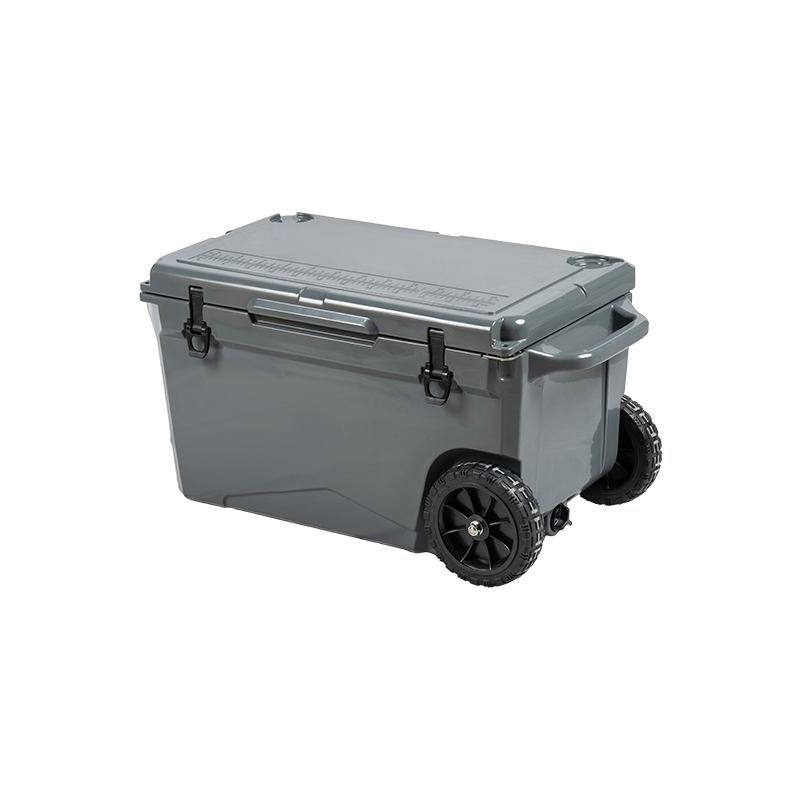
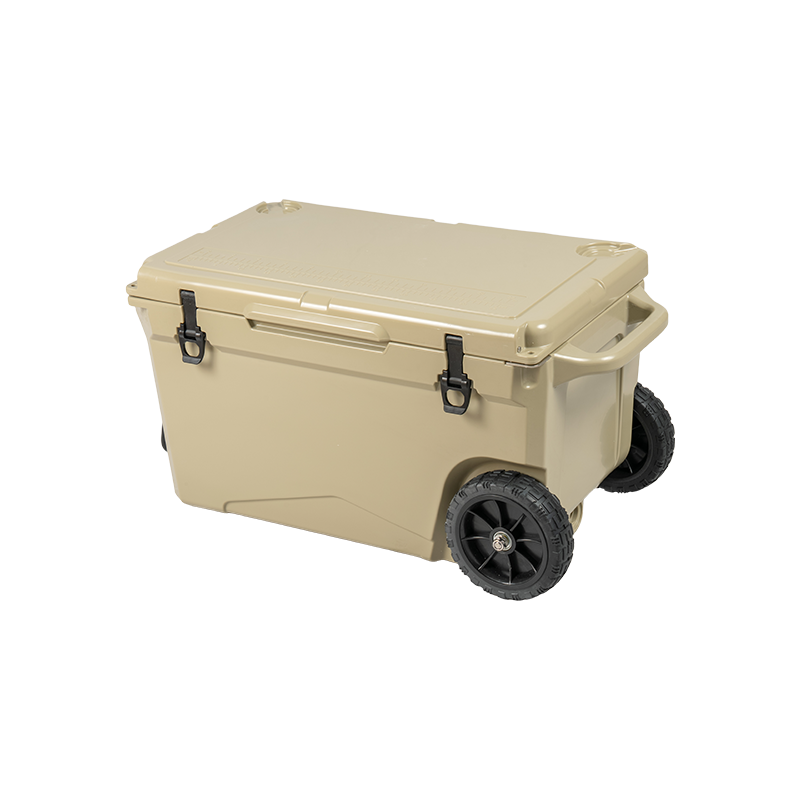 Wheeled 60-Quart Rotomolded Cooler for Heavy Camping LoadsThis rotomolded 60-quart cooler stands out for its wheeled design, easing movement when fully loaded with ice, drinks, and food. Pair it with the lid-sealing advice above to judge real-world ice retention.View Product →
 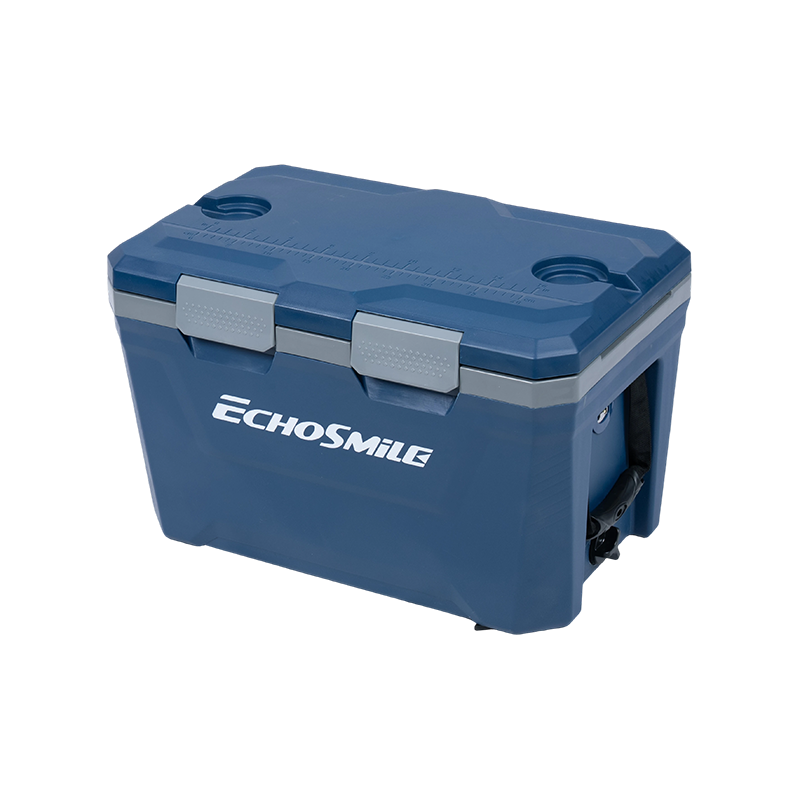 Portable 35-Quart Injection-Molded Cooler with Optional Tap and StrapsAn everyday portable cooler with PU foam insulation and optional water tap or backpack strap, suited for short trips and vehicle use. Consider it when a lightweight, easy-to-carry box beats a heavier rotomolded model.View Product →
The Lid, the Gasket, and Every Small Leak Path
Wall insulation stops most heat, but the seam between the lid and the body is the most common failure point. A box with excellent walls and a poorly sealed lid will melt ice faster than a box with average walls and a tight seal. The seam is where you should focus your attention.
Why the gasket is the most important part
A gasket is a continuous strip of closed-cell foam or rubber that sits between the lid and the body rim. When the latches pull the lid down, the gasket compresses and blocks air exchange. Over time, foam gaskets can take a set and stop returning to shape; a compressed, flat gasket lets warm air leak through invisibly. Test the seal by laying a strip of paper between the gasket and rim, then closing the latch: if the paper slides out easily, the seal is loose throughout that section.
Latches: compression is key
There are two kinds of latches: snap latches and compression latches. Snap latches close on a simple hook and may not press the lid hard enough to compress the gasket. Compression latches have an over-center mechanism that pulls the lid down firmly as they close, creating a dependable seal. In marine and fishing boxes, compression latches are near-universal because they stay closed in rough water.
Hinges, drain plugs, and vent valves
Hinges carry the weight of the lid, and a loaded lid can be heavy. Look for hinges with metal through-pins rather than molded plastic shoulders, which crack after a few seasons. Drain plugs are practical but are also a through-hole in the wall; a good plug is a threaded, gasketed stopper that seals dry and closes flush so it does not catch on luggage or boat decks.
Pressure-equalization valves solve a subtle problem: as the air inside a closed cooler warms, pressure rises and the lid becomes difficult to open. A small valve allows the pressure to release while keeping water out even when the box is turned upside down. This matters most aboard boats, where a warm lid that suddenly releases can spray water into the cargo area.
Ice Retention Ratings and What They Mean in the Real World
Manufacturers quote ice retention numbers such as "three days" or "five days", but those numbers come from standardized tests, not from your beach trip. Understanding how tests work helps you interpret the numbers and predict your own results.
How standardized ice retention tests work
Typical industry testing works like this: a cooler at a defined temperature is filled with a set amount of ice, often a 1:1 or 2:1 ice-to-cooler volume ratio, the lid is closed, and the box is kept in a controlled warm environment, commonly around 32°C. At scheduled intervals, an operator opens the lid for a short period, and the test ends when the internal temperature rises above a threshold or the ice has fully melted. These conditions are designed to produce repeatable comparisons, not to reproduce any specific campsite.
What the test does not show: sun exposure, pouring rain, sandy latches, frequent opening by children, or contents pulled out and put back. In real life, ice retention can easily be half of the published number, or double it, depending on behavior.
Variables that dominate real-world ice retention
- Ambient temperature: at 21°C you might get three times the ice life you get at 38°C.
- Contents temperature: warm groceries start melting ice immediately; frozen bottles of water do double duty as both cold mass and drinking water.
- Pre-chilling the box: a box that was cooled overnight starts with cold walls, saving the ice from cooling the box structure itself.
- Opening frequency and duration: each open lid swaps cold air for warm air.
- Sun and airflow: shade and a light-colored shell keep the outer surface cooler.
- Ice-to-content ratio: more ice means longer life; 2:1 is the guideline for multi-day use.
As a rule, a well-sealed rotomolded cooler with block ice and a 2:1 ratio will keep ice for three to seven days in moderate summer conditions. A good injection-molded cooler under the same conditions will usually deliver one to two days. Commercial insulated fish tubs with very thick walls sit at the top of the scale: packed with block ice and fresh seafood, they are engineered to hold near-freezing temperatures over a multi-day logistics chain. These are realistic expectations, not marketing promises.
Specialized Types: The Same Principle, Different Priorities
A cooler box does only one thing thermodynamically, but it must do that thing in very different environments. Manufacturers therefore adapt the shell, the lid, the hardware, and the capacities to the job.
Marine and fishing coolers
Salt air, spray, and UV are brutal for a cooler. Marine boxes add UV-stabilized LLDPE so the shell does not fade and turn brittle, non-corrosive hardware, and sealed hinges. Many fishing models integrate a fish ruler into the lid, recessed cup holders, tie-down slots for boat deck cables, and non-slip feet. The seal is still king: a fishing cooler is opened constantly, and seawater on the gasket accelerates wear. The large-capacity sea fishing rotomolding coolers are the upper end of this category, built to hold a day's catch as well as drinks for a crew.
Insulated fish tubs for commercial seafood transport
Once the catch moves from recreational to commercial scale, the cooler box becomes an insulated fish tub: a thick-walled, rotomolded, seamless container sized in liters rather than quarts. Tubs from 100 to 800 liters or more are loaded with gutted fish and ice on the boat, then stacked in trucks for the journey to auction or processing. The working principle is identical to a picnic cooler, but the stakes are different: a few degrees of temperature rise can spoil a whole batch, which is why these tubs use the thickest practical walls, food-grade LLDPE interiors that are easy to sanitize, and structural ribs instead of smooth decorative panels.
Because they are seamless, fish tubs do not leak and do not let seawater contamination into the insulation. Large market operators also use them for multiple steps in the cold chain: incoming fish, outgoing packaged product, and even ingredient storage in processing sites. If you handle seafood at a professional level, a rotomolded insulated fish tub is not an accessory; it is part of the cold chain itself.
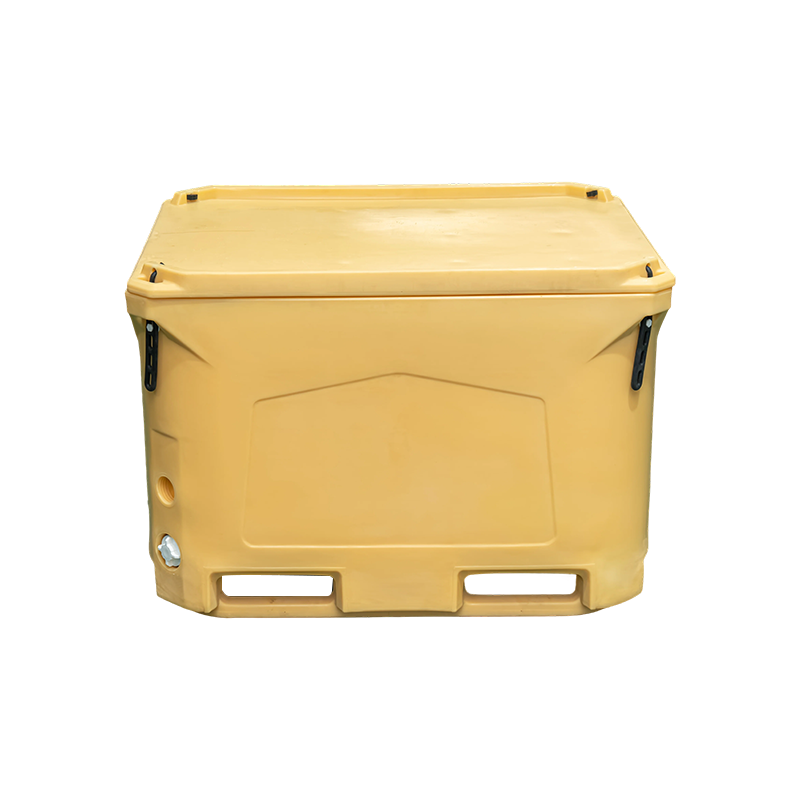 330-Liter Rotomolded Fish Tub for Medium Seafood BatchesA food-grade LLDPE rotomolded tub with PU insulation, sized for medium seafood batches and dockside sorting. Optional casters ease repositioning, making it a practical cold-chain tool after vessel landing.View Product →
Car-mounted and portable coolers
Compact boxes from 10 to 45 quarts are built to live in a vehicle. Their design priorities are a footprint that fits between wheel wells, handles that are comfortable with gloves, and lids that stay shut during acceleration and braking. Some models are low-profile enough to slide under a car seat and are therefore common in overlanding and work-truck setups. The insulation is thinner than in a large rotomolded box, so they are best for day trips rather than multi-day expeditions.
Multi-function designs
The same thermal mechanism can be packaged with double uses. A notable example is a cooler combined with a folding table and integral stools: the box works as a table base and seating while continuing to keep drinks cold. These hybrids are popular for family outings where camp furniture and cold storage are needed in one vehicle load. They show that the working principle does not restrict the design language; it only requires a sealed, insulated cavity around the contents.
Using the Mechanism: How to Get the Most from a Cooler Box
Once you understand the physics, the operating instructions write themselves. Every practice below is simply a way of minimizing heat gain or maximizing the ice's ability to absorb heat.
- Pre-chill the empty box. A day before departure, put a bag of ice or frozen packs inside and leave the lid closed. Cold walls mean the first heat load on the ice is the contents, not the structure of the box.
- Pre-chill the contents. This is the single cheapest improvement you can make. A warm six-pack consumes ice that could otherwise last for hours; cool everything overnight whenever possible.
- Pack from the bottom up: block ice at the bottom, then a layer of chilled contents, then loose ice between and on top. Cold air sinks, and an ice base keeps the bottom and the center of the load stable.
- Fill the empty space. Air is the enemy of a partially loaded cooler. Use frozen bottles of water or rolled towels to displace the air; you add cold mass and reduce convective circulation inside.
- Drain only when necessary. Meltwater at 0°C is still cold; removing it discards cold capacity. Drain just enough to keep food dry or to free space.
- Keep the box closed, in the shade, and slightly elevated. Elevation allows air to circulate beneath, shade reduces radiative load, and every second of lid-open time is paid for by the ice.
If your box "does not hold ice" but you see excessive flex in the walls or a noticeable hiss of air when the lid closes, the box itself is the problem. If the box is rigid and seals tightly, the problem is almost always in one of the six habits above.
When Active Cooling Makes Sense
The term "cooler box" is sometimes applied to devices that do not follow the passive principle. Thermoelectric and compressor coolers actively pump heat out, and they are worth understanding so you can choose the right tool for the job.
Thermoelectric coolers
Inside a thermoelectric cooler, an electric current passes through a sandwich of two semiconductors. One side absorbs heat and becomes cold; the other rejects heat and becomes hot. A small fan moves air across the cold side to cool the cabinet. These units are light, quiet, and can draw from a 12V outlet, which makes them popular in cars and trucks. Their limitation is that they cannot cool far below ambient temperature, and their cooling capacity drops as the cabin warms. They are best for keeping a few drinks pleasantly cold during a day drive, not for freezing or for long off-grid stays.
Compressor coolers
A compressor cooler contains a sealed refrigeration loop: an electric compressor pressurizes refrigerant gas, the gas releases heat as it condenses, then expands and evaporates inside the cabinet, absorbing heat in the process. This is the same cycle as a household refrigerator. Compressor coolers can hold a set temperature as low as -20°C regardless of ambient heat, which makes them the standard choice for medical cold chain, frozen food, and demanding overlanding uses. They pay for that capability with weight, noise, power demand, and moving parts that can fail over time.
Why passive boxes remain relevant
A passive cooler box has no compressor to fail, no battery to drain, and no electronic control to malfunction. It works at -30°C and at +40°C with the same simplicity, and it holds ice for days if packed correctly. Active coolers solve a different problem: they maintain a fixed temperature indefinitely, as long as power is available. There is no winner here, only fit. A marine fisherman needs a passive box that will never quit; a medicine courier needs a compressor unit that will hold -20°C overnight.
Buying and Sourcing a Cooler Box with the Mechanism in Mind
Now that the working principle is clear, the evaluation criteria become concrete. Whether you are choosing a cooler for your family or choosing a factory for your brand, check the same things.
For individual buyers
- Wall thickness and stiffness: press the side wall and the lid; a thin wall flexes visibly and costs you ice retention.
- Seal quality: close the lid without latching and feel for air escaping; then latch it and press the gasket with your finger - the gasket should feel soft and springy, not flat and hard.
- Hinge construction: prefer through-pinned hinges that are bolted into molded bosses, rather than self-tapping screws into thin plastic.
- Drain plug design: a recessed, gasketed plug that seals flush is less likely to leak or be knocked loose.
- Material compliance: for food contact, confirm the product is made from food-grade plastic such as HDPE or LLDPE, and look for FDA-compliant formulations or available test reports if you plan to store food directly.
For brands, distributors, and OEM buyers
When you source coolers as a private-label product, the supplier's molding capability is the product. A manufacturer that controls its own tooling can change capacity, wall thickness, color, and logo without coordinating with an outside mold shop. Ningbo Nelgreen Outdoor Products is an example of this full-process model: it designs and builds molds, runs both rotomolding and injection molding production, and offers OEM and ODM services across outdoor coolers, marine coolers, and industrial insulated fish tubs.
Ask a potential supplier for hard documentation, not adjectives. Reasonable exporters can provide food-grade material certificates, temperature retention test results, quality management certifications such as ISO 9001, and compliance evidence for RoHS and FDA food-contact requirements. BSCI social audits and SGS inspection reports are also common in this category. A factory that answers technical questions with data is far more valuable than one that answers with slogans. If you want to move from general questions to a real discussion of specifications, capacities, and mold development, the fastest route is to contact the factory directly.
A cooler box is a simple machine with a simple duty: it slows heat entry so that the ice inside can do the cooling. The performance comes from four linked decisions - the thickness and quality of the insulating foam, the tightness of the lid and gasket, the choice of rotomolded versus injection molded construction, and the way the box is packed and used.
Now you can see why the two families at the lake had two different weekends. The family that opened the box less, kept it in the shade, packed more ice, and bought a box with thick seamless walls and a genuine compression gasket came home with ice intact. The box did not make that cold; it simply protected it. That protection is the entire technology, and it is worth paying for.
Our R&D team has over 15 years of rich experience in the field of rotational molding products and has applied for 6 product patents. The number of factory employees has exceeded 100. Strict management and quality control have enabled us to take the leading position in the industry. In addition, the experienced sales team can provide customers with a variety of solutions and high-quality services.
Related products
-
-
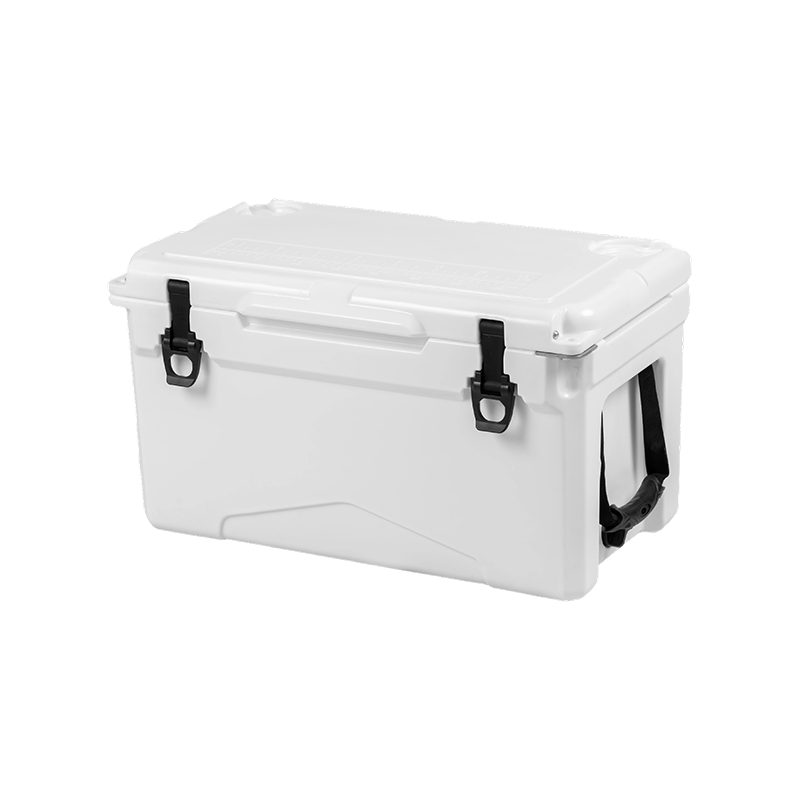
The 30QT NL-30 stands out for its elongated body, with an interior of about 46.2 × 23.6 × 26.1 cm. At this capacity, the extra usable length is particularly helpful for fish, long bottles and elongate...
See Details -
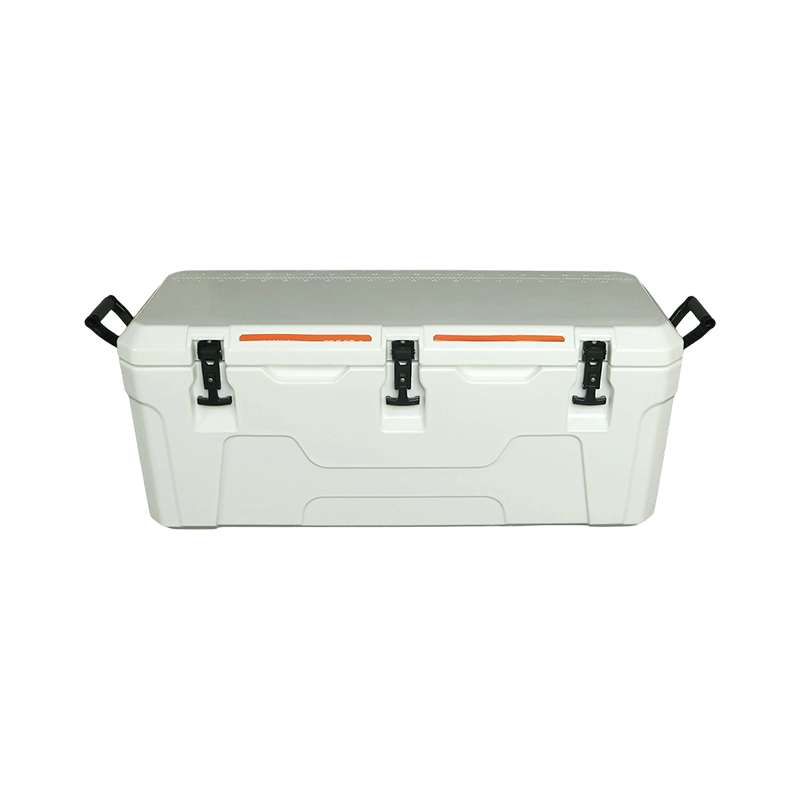
The 140QT NL-140 has an interior of about 105 × 32 × 38 cm, and its more-than-one-meter usable length is the key advantage of this model. It is better suited to larger fish, longer catch and supplies ...
See Details -
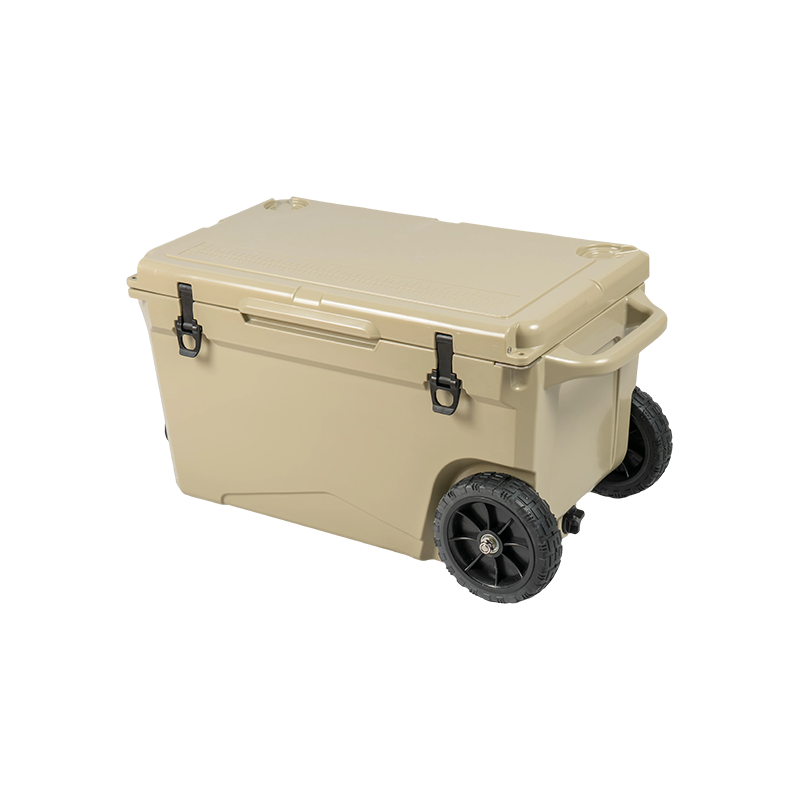
The 75QT NL-75 is a large wheeled model with an interior of about 66.2 × 34.1 × 35.8 cm. It is suited to offshore fishing, boating, family barbecues and group events where more ice, drinks, food or ca...
See Details -
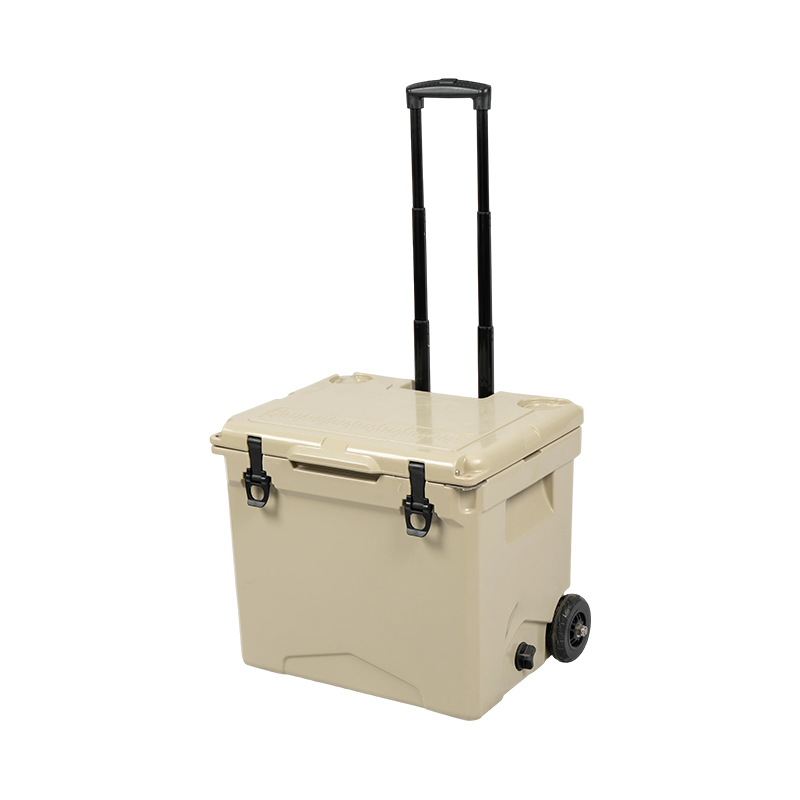
The 45QT NL-45 has a deeper interior of about 41.8 × 29.9 × 30.4 cm, making it useful when vertical storage matters. Taller food containers, bottled drinks and campsite supplies can be packed upright ...
See Details -
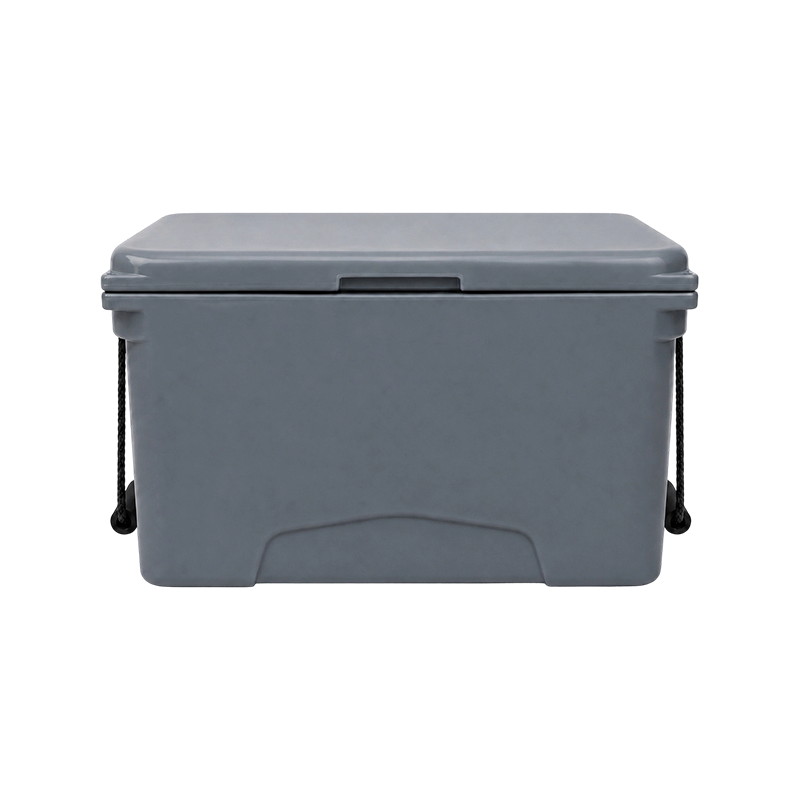
The 65QT NL-65 has an interior of about 60.5 × 33.5 × 32 cm, providing enough room for group weekend supplies or a larger catch while keeping proportions practical for vehicles and boats. The rotomold...
See Details
Related News
-
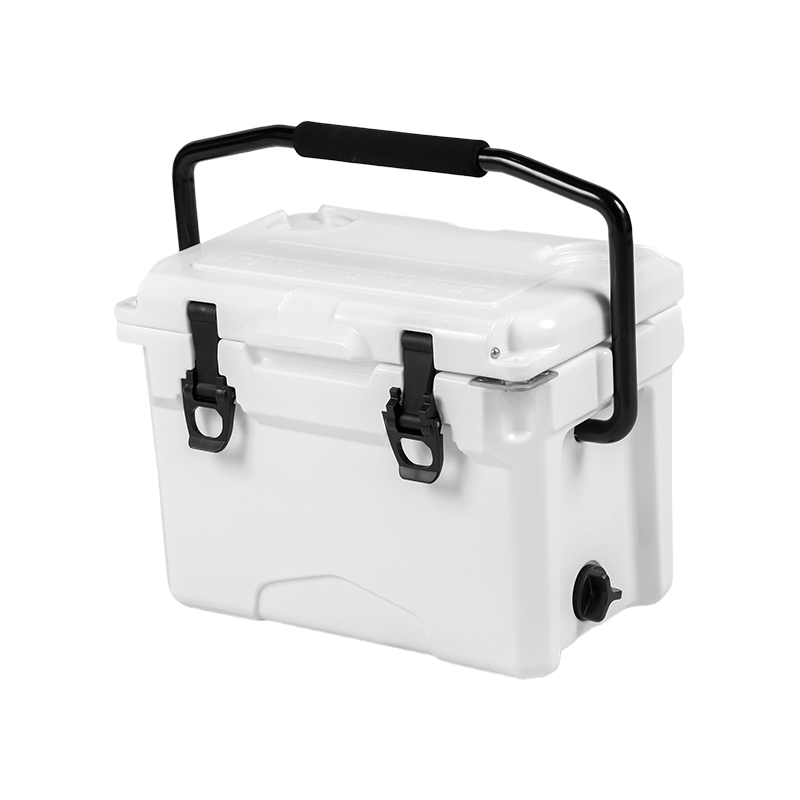
Why Choose a Rotomolded Cooler? Rotomolded Coolers: A Brief Introduction The Pinnacle of Portable Cooling Technology The modern era of outdoor recreation and de...
See Details -
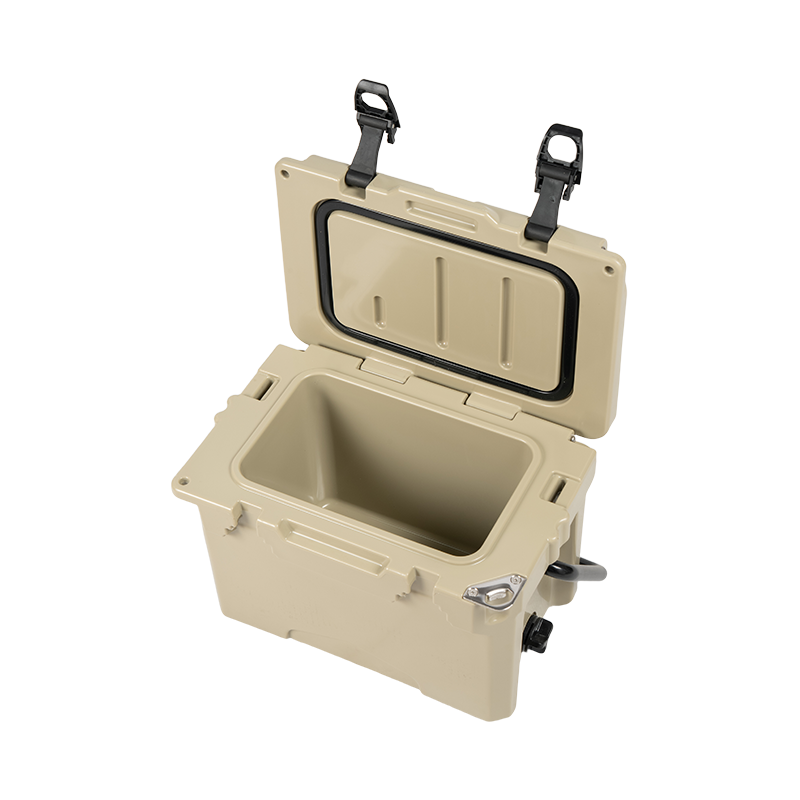
Introduction to Insulated Fish Tubs When you're out on the water, whether it's a deep-sea fishing trip or a relaxing day at the lake, the freshness of your catc...
See Details -
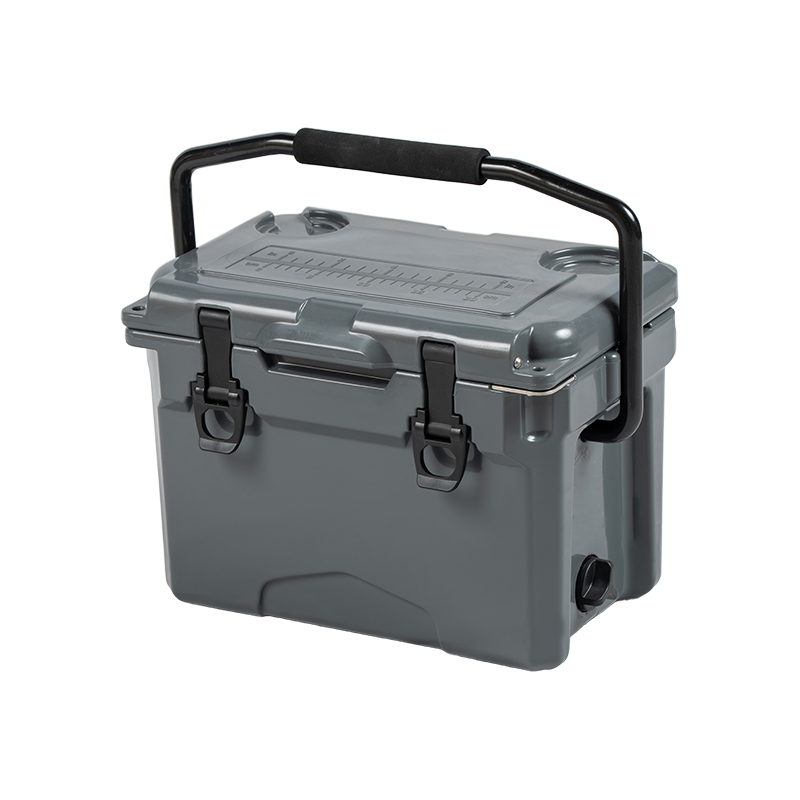
1. Insulation Quality in Outdoor Cooler Boxes When choosing an outdoor cooler box, one of the most critical factors to consider is insulation quality. The insul...
See Details -
The Unmatched Advantage of ROTOMOLDING COOLER BOX Defining the Premium Standard: What exactly is a ROTOMOLDING COOLER BOX? The ROTOMOLDING COOLER BOX is not mer...
See Details
Be the First to Know
For exclusive deals and the latest offers, sign up by entering your email address below.


Contact Info
 No. 6, Guantong Road, South Zone, Xiaocaoe Town Industrial Park, Ningbo, Zhejiang, China
 +86 13736107260
  [email protected]
 Qr Code



Copyright © Ningbo Nelgreen Outdoor Products Co., Ltd. All Rights
Reserved
 OEM/ODM Seafood Insulated Boxes Manufacturers